
Investment Readiness: Privacy Compliance Basics

Investment Readiness: Privacy Compliance Basics
Investors care about privacy compliance because it shows you can handle data responsibly and avoid regulatory risks. It’s not just about protecting sensitive information - it’s about building trust and proving you’re ready to scale. Poor practices can lead to fines, drag down valuations, or even kill deals. On the flip side, having a solid privacy framework can make your business more attractive to investors.
Here’s what you need to know:
- Privacy compliance is about meeting legal requirements like UK GDPR, the Data Protection Act 2018, and, if applicable, HIPAA for US health data.
- Investors expect you to have clear policies, secure systems, and proper documentation.
- The basics include data audits, lawful data processing, managing consent, and handling data subject rights.
- Weaknesses like missing records, unclear legal bases, or poor security can raise red flags during due diligence.
- Strong privacy practices can help boost valuations and smooth out the investment process.
Take action now: Start by mapping your data, setting up policies, and securing your systems. Get your team trained, document everything, and be ready to show investors you’ve got privacy covered.
Want to know more? Let’s dive into the details.
Sectoral Privacy Laws and Compliance | Exclusive Lesson
Key Privacy Regulations and Their Business Impact
Navigating privacy laws isn’t just about ticking compliance boxes - it’s also about earning investor trust. Investors are keen to see robust controls in place to avoid enforcement risks and protect reputations. These regulations shape how businesses operate and can directly influence investor confidence.
GDPR and UK GDPR
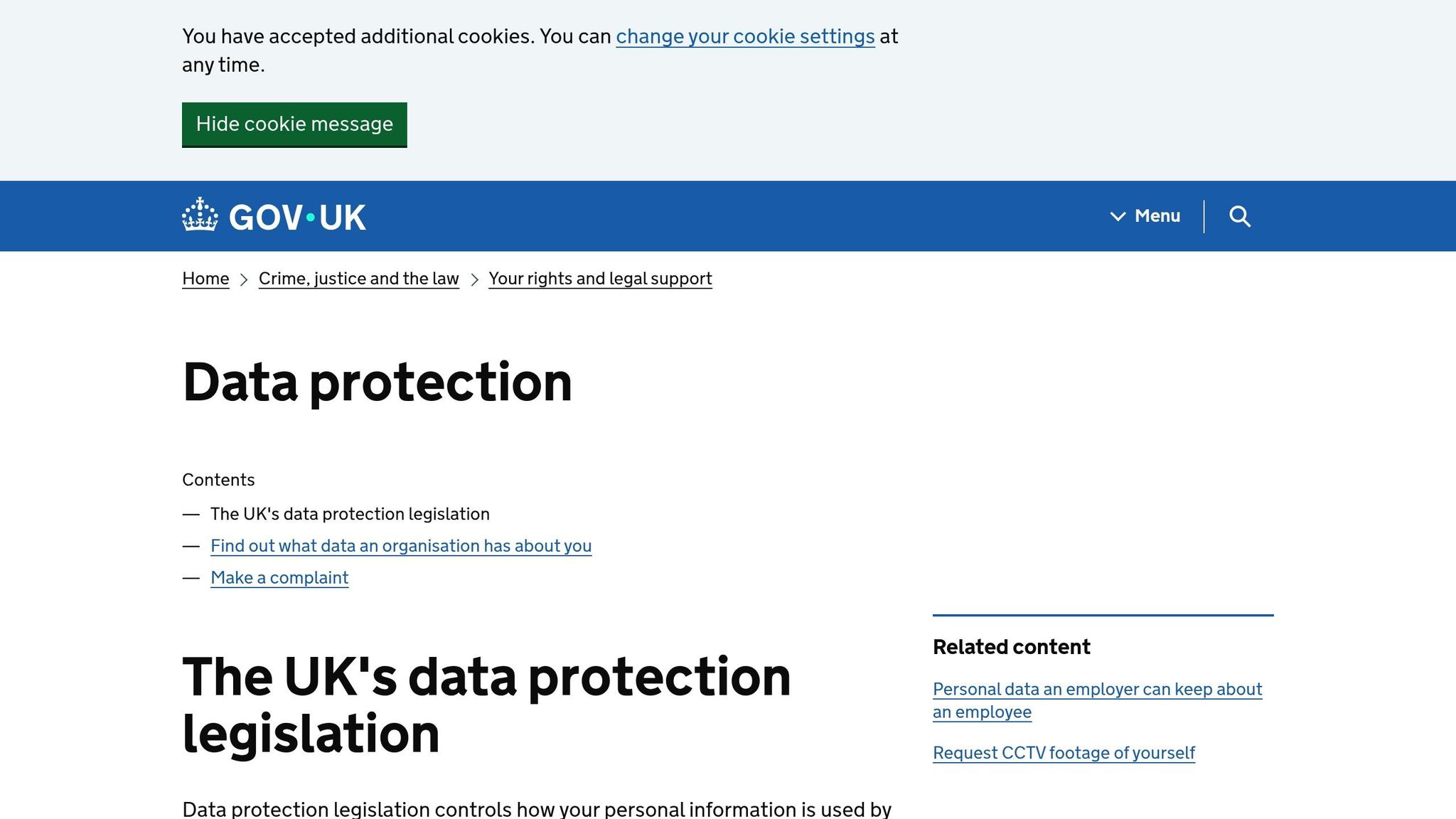
In the UK, privacy laws are governed by the UK GDPR and the Data Protection Act 2018. These apply whenever personal data is processed in the UK. If your business targets or monitors individuals in the European Economic Area (EEA), the EU GDPR kicks in as well.
A key requirement under these regulations is ensuring every data processing activity is based on a lawful basis. Options include consent, contract, legal obligation, vital interests, public task, or legitimate interests. For example:
- Use "performance of a contract" when delivering services.
- Rely on "legitimate interests" for analytics.
- Obtain "consent" for marketing activities.
Handling special category data - like health records, biometric data, or information on racial or ethnic origin - requires extra care. This means conducting Data Protection Impact Assessments (DPIAs) and implementing stronger security measures. It’s also crucial to know your role: are you a controller, joint controller, or processor? This determines responsibilities like drafting privacy notices, managing data subject requests, and setting up Data Processing Agreements (DPAs).
Investors will also examine how you manage data subject rights under the UK GDPR, such as access, rectification, and erasure. For instance, can you locate all instances of a user’s data, including backups and third-party processors? Can you handle deletion or export requests within the required timeframes? Your systems should support efficient data retrieval (think user-level identifiers in microservices), segregate test and production environments, and respect objections to marketing or profiling. Documenting these processes reassures investors that you’re ready to meet key milestones.
International data transfers are another hot topic, especially during due diligence. If you transfer data from the UK or EEA to other countries, you’ll need to map out and explain these flows. Safeguards like Standard Contractual Clauses (SCCs) or the UK International Data Transfer Agreement/Addendum are essential, along with Transfer Risk Assessments and encryption. Keeping an up-to-date list of sub-processors and having clear vendor onboarding policies will also work in your favour.
The consequences of non-compliance can be severe. Under the UK GDPR, fines can reach up to 4% of global annual turnover. For instance, in January 2023, the ICO fined British Airways £18.4 million for a data breach affecting 220,000 individuals. This shows just how costly inadequate compliance can be [1].
PECR and Electronic Communications
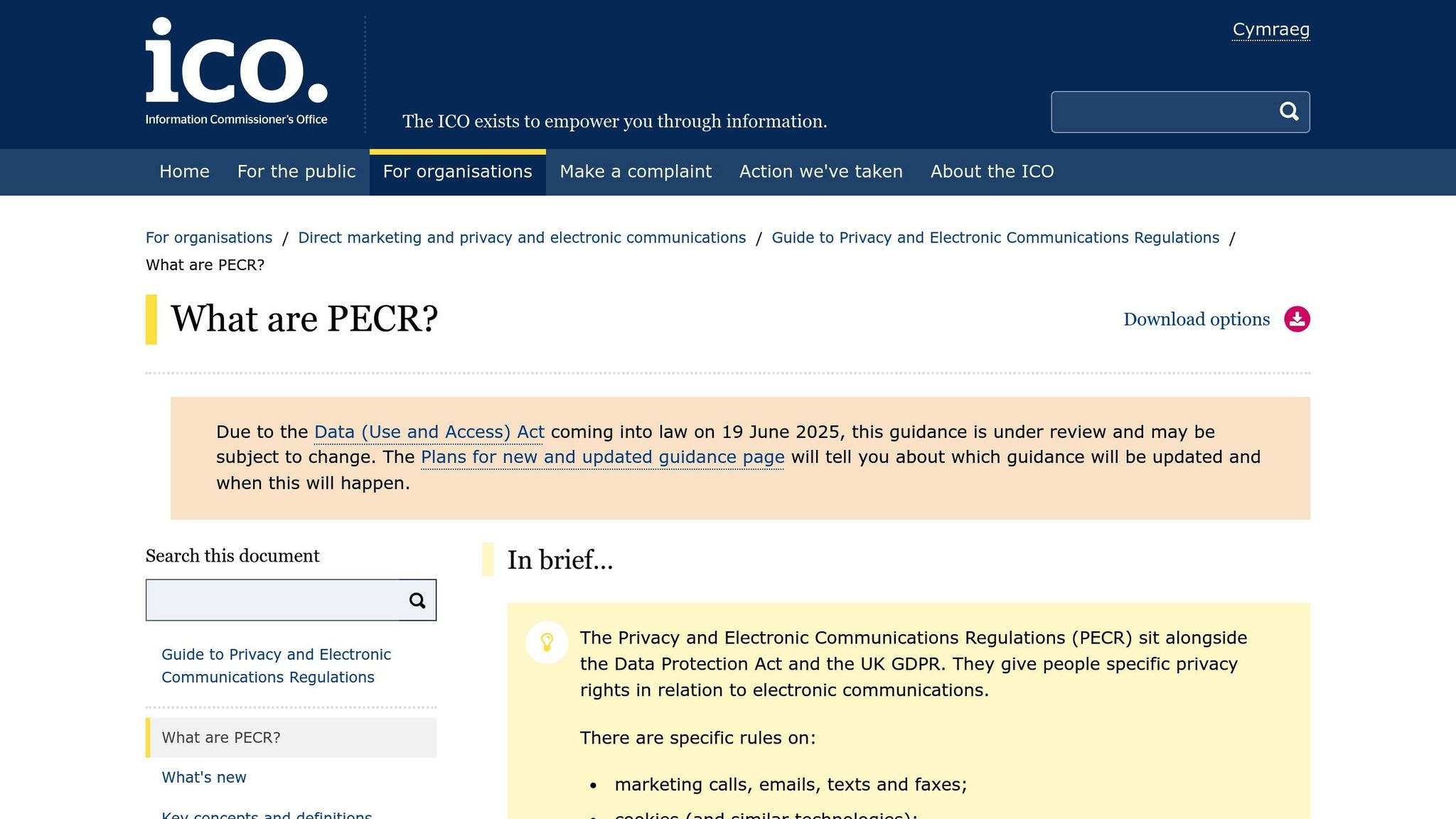
When it comes to electronic communications, the Privacy and Electronic Communications Regulations (PECR) step in to regulate cookies, tracking technologies, and marketing via email or SMS. PECR works alongside the UK GDPR, requiring informed consent before storing or accessing information on a user’s device - unless it’s strictly necessary for a service the user has requested.
For cookies and trackers, this means gaining consent for advertising or non-essential analytics tools. Investors will want to see clear cookie inventories, distinct consent options (like "essential", "analytics", or "marketing"), and detailed privacy or cookie notices explaining each category’s purpose and retention period. The same principles apply to mobile apps, particularly for software development kits (SDKs) and device identifiers.
PECR also governs direct marketing. Generally, you’ll need opt-in consent for marketing communications, though "soft opt-in" exemptions may apply for existing customers who had the chance to opt out during data collection. Keeping records of consent and offering easy opt-out options - like unsubscribe links in emails - are vital. For example, in January 2023, the ICO fined DoorDash UK £1.2 million for sending 1.2 million marketing emails without valid consent. This highlights how critical it is to follow these rules [1].
HIPAA for UK Companies Handling US Data
If your UK company handles Protected Health Information (PHI) for US clients, the Health Insurance Portability and Accountability Act (HIPAA) applies. This could be the case if you host patient data, analyse medical records, or run a telehealth platform for a US healthcare provider.
In these situations, your company likely qualifies as a business associate, meaning you’ll need signed Business Associate Agreements (BAAs) with US clients and key sub-processors. You’ll also need to implement HIPAA-aligned security measures, such as access controls, audit logging, encryption, backups, and disaster recovery plans. Workforce training and clear policies for managing breaches or non-compliance are equally important.
Investors will look for evidence of rigorous HIPAA-aligned protocols when handling US health data. Demonstrating compliance here not only protects sensitive data but also builds confidence among stakeholders who want assurance that you’re managing these responsibilities effectively.
Building a Privacy-Ready Business
Once you've got a handle on the key regulations, the next step is weaving privacy into your business operations. This isn't about slapping on a few policies at the last minute; it's about showing that privacy is part of your company's DNA. Investors want to see that you're serious about data responsibility, with systems in place that reflect this commitment. This means establishing proper governance, keeping essential documentation up to date, and implementing security controls that fit your business size and risk level.
Governance and Accountability
The accountability principle under UK GDPR is clear: you can't just say you're compliant - you need to prove it. This starts with proper governance. Someone in your company needs to own privacy, and this responsibility should connect directly to senior leadership and the board.
At a minimum, appoint a privacy lead. This could be your CTO, COO, or another senior team member. Make sure their role is documented, so it's clear who oversees privacy decisions - whether that's reviewing new features or responding to data subject requests.
A Data Protection Officer (DPO) is only legally required in specific situations, like large-scale monitoring or handling sensitive data, but many UK businesses choose to bring in an external or part-time DPO. This approach provides expert guidance without the cost of a full-time hire and shows investors that you're taking privacy seriously.
As your business grows - especially if you're aiming for Series A funding or beyond - investors will expect more structure. This includes clear reporting lines, defined escalation paths for incidents, and regular updates to the board on privacy matters. Using a simple RACI (Responsible, Accountable, Consulted, Informed) matrix can help clarify who does what for tasks like breach responses, vendor onboarding, and DPIAs (Data Protection Impact Assessments).
For companies looking for extra support, CTO-led partners like Metamindz can act as a bridge between your board, engineering team, and DPO, helping turn governance decisions into practical technical controls. This kind of framework ties your regulatory obligations to your day-to-day operations.
Policies and Documentation
Policies aren't just for ticking regulatory boxes - they're a way to show investors that you've thought through how you handle data. Regulators and investors alike want to see clear, concise documents that reflect your actual practices.
Start with external-facing documents like privacy and cookie notices. A good privacy notice should be easy to understand and cover the basics: what data you collect, why you collect it, your lawful bases, who you share it with, how long you keep it, individuals' rights, and how to contact you or your DPO. Skip the jargon - plain language and real-world examples work best.
Internally, you'll need a few key policies:
- A Data Protection or Information Governance Policy outlining principles, roles, and responsibilities.
- An Information Security Policy covering things like access control, device use, password policies, multi-factor authentication (MFA), backups, and incident reporting.
- A Data Retention and Deletion Policy specifying how long you keep data and how you dispose of it.
- An Incident or Breach Response Policy aligned with the UK GDPR's 72-hour notification rule.
You'll also need to maintain Registers and Records to turn these policies into action. For example:
- A Record of Processing Activities (RoPA) outlining what data you process, why, and how it's protected.
- A vendor or processor register listing tools and services that handle personal data, along with risk ratings and signed Data Processing Agreements (DPAs).
- DPIAs for high-risk activities like AI-driven decision-making or handling sensitive health data.
- Logs of training and awareness activities and any incidents or breaches, even minor ones.
For early-stage businesses, simple spreadsheets or lightweight tools can do the job, as long as they're accurate and regularly updated. Investors often ask to see these documents during due diligence, so even basic but current records are far better than fancy templates gathering dust.
Security and Data Management Controls
Policies and governance are great, but they're not enough on their own. You need solid technical controls to back them up. Privacy regulations require "appropriate technical and organisational measures" to secure data, and investors expect you to meet certain baseline standards.
Here are a few essentials:
- Role-based access control (RBAC): Only give access to people who actually need it, and review permissions regularly.
- Strong authentication: MFA is a must these days. It’s one of the simplest ways to prevent unauthorised access.
- Encryption: Encrypt data both in transit and at rest, and use strong key management practices. This protects your data if a device is lost or a system is breached.
Vendor risk management is another big one. Many data breaches start with third-party tools or processors, so keep a detailed inventory of vendors handling personal data. Do your due diligence before onboarding them, and document these checks.
Finally, have an incident response plan in place. Define what counts as an incident, how you'll triage it, and who makes the call on notifying the ICO or affected individuals. Investors want to know that you can handle incidents effectively - detecting, containing, documenting, and learning from them.
As your company scales, you'll likely need to step up your game with formal risk assessments, penetration testing, and security certifications like Cyber Essentials or ISO 27001. CTO-led teams like Metamindz can help you implement these controls without overcomplicating things, ensuring you meet both regulatory and investor expectations.
Building a privacy-ready business is about laying the groundwork for sustainable growth. Proper governance ensures accountability, clear documentation shows your commitment, and strong security controls protect your operations. Together, these elements reassure investors that you're prepared to handle privacy challenges as you scale.
Step-by-Step Privacy Compliance Roadmap
After covering the basics of privacy, let’s break down the steps to ensure compliance as your company grows. This roadmap focuses on practical actions tailored to early-stage startups, helping you meet the expectations of regulators and investors without overcomplicating things. Whether you're pre-seed, seed, or Series A/B, these steps will set you up with solid privacy practices that can scale as you do.
Pre‑Seed and Seed Stage Priorities
In the early days, investors are looking for the essentials - proof that you know your data, understand the risks, and aren’t setting off any obvious alarm bells. The goal here is to show you're serious about privacy, without getting bogged down in heavy, time-consuming frameworks.
Start with data mapping. Use a simple spreadsheet to track personal data - where it comes from, where it’s stored, and who has access. This will be one of the first things investors check during due diligence, so it’s worth getting it right early on.
Next, identify the lawful basis for each data processing activity. Whether it’s contract fulfilment or legitimate interests, make sure you document your reasoning. This will save you from awkward questions later.
You’ll also need clear, plain-language privacy and cookie notices for your website or app. These should explain what data you collect, why you collect it, who you share it with, how long you keep it, and how users can exercise their rights.
Set up simple processes for handling data subject rights (like access or deletion requests) and logging breaches. Make sure you know the drill - under UK GDPR, you’ve got 72 hours to report a breach to the ICO.
Don’t skip the basics when it comes to security controls. Measures like role-based access, multi-factor authentication, encryption, and backups are not just good practice; they’re also the kind of things investors expect as standard.
Finally, provide some privacy awareness training for your team. Make sure everyone knows what personal data is, why it matters, and how to handle it if something goes wrong.
Need help pulling it all together? Working with a fractional CTO or a partner like Metamindz can make a big difference. They can help you prioritise what’s investor-critical and create a "privacy workbook" that tracks your systems, datasets, and responsibilities - an asset that’s often a hit with early investors.
Scaling for Series A and Beyond
Once you’ve nailed the basics, it’s time to level up. By Series A, investors will expect a more structured and mature compliance framework. Privacy compliance needs to move from being "good enough" to something you can confidently prove.
Start by formalising your Record of Processing Activities (RoPA). While not strictly required under UK GDPR, many investors will want to see a detailed log of your processing activities, including data categories, purposes, legal bases, retention periods, and third-party involvement. Keep it updated as your company evolves.
Introduce risk assessments and Data Protection Impact Assessments (DPIAs) for high-risk activities. For example, if you’re launching a feature that involves profiling, sensitive data, or automated decision-making, a DPIA shows you’ve considered the risks and taken steps to mitigate them before launch.
Set up structured governance. Assign clear roles - whether it’s a Data Protection Officer (DPO), privacy lead, or security lead - and schedule regular risk reviews. You might even create a privacy committee or make privacy a recurring agenda item in leadership meetings. Don’t forget to provide regular privacy and security training, especially for engineers and customer-facing teams.
Improve your vendor management. Maintain a register of all your processors and sub-processors, conduct due diligence with security and privacy questionnaires, and ensure you’ve got Data Processing Agreements (DPAs) in place for any non-UK/EEA vendors. Investors will often want to review this register and sample agreements during due diligence.
Move towards measurable controls and monitoring. Schedule regular access reviews to ensure permissions are still appropriate. Use centralised logging to flag unusual activity, and carry out regular penetration tests or security assessments. Document everything - investors like to see evidence of follow-up actions and improvements.
Finally, embed privacy by design into your product development. Add privacy checkpoints during the design phase, run threat-modelling sessions for new features, and update documentation whenever your systems or processes change. This not only builds trust with customers but also reassures investors that privacy is part of your DNA.
A CTO-led team like Metamindz can help you scale these measures, ensuring your technical controls grow alongside your product while keeping privacy at the core of your architecture.
Aligning Compliance with Funding Milestones
As your business grows, privacy compliance will face increasing scrutiny from investors. To stay ahead, align your efforts with the level of due diligence expected at each funding round.
Before pre-seed or seed pitches, be ready to answer:
- What data do you collect?
- Where is it stored?
- Who has access to it?
- What happens if there’s a breach?
At this stage, you’ll need at least one privacy notice, a basic information security policy, and a simple incident response plan. These demonstrate that you understand the risks and have a workable approach, even if it’s still early days.
Before Series A, you’ll need to show more evidence of your compliance efforts. This might include a data map or RoPA, a security architecture overview, DPIA examples, vendor lists, and key policies. Investors may also send formal due diligence questionnaires, so be prepared with supporting documents like training logs, audit reports, or penetration test summaries.
For Series B and beyond, expect more formal certifications or attestations. Investors may want proof that you align with recognised frameworks like ISO 27001, along with independent penetration test results and comprehensive privacy or security audit reports. You’ll also need to show that privacy isn’t just a box-ticking exercise - it should be embedded in your company’s culture and operations.
sbb-itb-fe42743
Demonstrating Privacy Readiness to Investors
When investors evaluate your business, they’re not just giving your privacy policy a quick glance. They’re digging deeper, looking for proof that privacy compliance isn’t just a box-ticking exercise but is fully embedded in your operations and scalable as you grow. Today, data protection and privacy compliance are seen as material risks, and investors often conduct rigorous due diligence, blending cybersecurity and data protection assessments. It’s not uncommon for them to demand independent technical and privacy audits to confirm your claims.
To show you’re ready, you need to demonstrate that privacy is a core part of how you run your business. This means having up-to-date documentation, addressing potential red flags proactively, and presenting a clear narrative that ties privacy into your overall governance and risk management strategy. Here’s how you can make your case to investors.
Preparing Privacy and Security Documentation
Your investor data room needs to be organised, comprehensive, and up-to-date. Missing or outdated documents will raise eyebrows - probably not the reaction you’re hoping for.
Make sure you include key documents such as privacy policies, data protection policies, security policies, incident response plans, data retention schedules, access control policies, and procedures for handling data subject rights. These documents should be current, version-controlled, and show regular review dates. Investors want to see that these aren’t just static files but are actively maintained.
For UK GDPR compliance, ensure your Records of Processing Activities (RoPA), Data Protection Impact Assessments (DPIAs), and vendor contracts are up-to-date. Include detailed data flow diagrams that map out your systems, processors, and data storage locations, especially if data crosses borders. If you’re handling sensitive data - like health, biometrics, or children’s information - highlight this in your data map.
Risk assessments are another must-have. Provide DPIAs for high-risk activities, such as behavioural profiling, AI models using personal data, or automated decision-making. If you’re relying on "legitimate interests" as a lawful basis, include your Legitimate Interest Assessments (LIAs) to back it up.
Investors will also scrutinise your contracts. Include both templates and signed agreements like Data Processing Agreements (DPAs), Standard Contractual Clauses (SCCs) or International Data Transfer Agreements (IDTAs), and Business Associate Agreements (BAAs) if HIPAA applies. Don’t forget to include privacy and security clauses in your customer contracts.
Training records are equally important. Provide evidence of training sessions - like completion stats or materials from induction and refresher courses. If you’ve run phishing or security-awareness campaigns, include those records too.
Lastly, maintain detailed incident and request logs. Investors want to see how you’ve handled security incidents, even those that didn’t require regulatory reporting. They’ll also look at how you manage Data Subject Rights (DSR) requests, such as access, erasure, or rectification, and whether these are resolved within required timeframes.
Organise your data room into clear folders, such as "01 Governance", "02 Policies", "03 Registers & DPIAs", "04 Security & Incidents", "05 Vendors & Transfers", and "06 Training & Culture". At the top, include a short "Privacy & Security Overview" (one to two pages) that summarises your approach, key risks, and roadmap in plain English. Use consistent naming conventions (e.g., Privacy_Policy_v3.1_2024-09-15) and add brief notes in each folder to explain how UK GDPR requirements - like lawful basis, DSRs, and international transfers - are addressed. If you have gaps, don’t leave them unexplained. Instead, include a plan with timelines for resolving them.
Addressing Investor Concerns
Once your documentation is ready, tackle common investor concerns to strengthen your compliance stance.
Investors often flag issues that suggest weak governance or regulatory risks. Addressing these proactively can prevent hiccups during due diligence.
One major red flag is an unclear lawful basis for processing activities. Over-reliance on "legitimate interests" without proper LIAs or invalid "consent" claims can cause concern. Clearly document the lawful basis for each processing activity and ensure your consent mechanisms, especially for marketing and cookies, meet UK GDPR and PECR standards.
Missing or outdated RoPA, DPIAs, or data maps can make investors think you don’t fully understand your own data flows. Make sure these documents are accurate and up-to-date before due diligence begins.
Vendor due diligence is another focus area. Investors want to see clear DPAs, transfer mechanisms, and documented assessments for your vendors. Show them you’ve done your homework here.
A lack of evidence for breach detection and incident response - or undisclosed past incidents - will also raise questions. Be ready to demonstrate how you detect, manage, and report breaches. If you’ve had incidents in the past, provide a post-mortem that explains what happened, any regulatory notifications, and the steps you’ve taken since to prevent recurrence.
International data transfers are a persistent worry. If you’re moving data outside the UK or EEA, make sure you’ve got proper mechanisms like SCCs or IDTAs in place. Show investors you’re on top of cross-border data transfer rules.
Finally, gaps in staff training or weak joiner/mover/leaver controls can signal that privacy isn’t fully operational. Misalignments between your product’s behaviour and your public privacy notices are another red flag. These issues can lead to valuation cuts, indemnities, or deal conditions.
To get ahead of these concerns, conduct a privacy gap assessment 3–6 months before your funding round. Focus on high-risk areas like sensitive data, children’s data, or large-scale tracking. Update your RoPA, DPIAs, and vendor contracts to align with UK GDPR standards. Strengthen your security measures - like multi-factor authentication, least-privilege access, and encryption - and document these with screenshots or reports. Address quick fixes, such as missing policies or a lack of a breach playbook, and record unresolved risks in a risk register with clear action plans. Be ready to explain both your completed improvements and your future plans.
If this all feels overwhelming, a CTO-led partner like Metamindz can help. They combine gap analysis, architecture updates, and contract reviews into a single investor-ready package. As Tanya Mulesa, Founder of Aeva Health, puts it:
What truly sets him apart is his rare combination of deep technical expertise and business acumen, coupled with a genuine investment in seeing others succeed. His ability to assess technical challenges and architect solutions while considering the broader business context has been invaluable. ... His talent for translating complex technical concepts into clear, actionable insights for non-technical stakeholders is remarkable.
Integrating Privacy with Broader Governance Programmes
Privacy isn’t just a standalone issue - it’s part of your overall risk management. By integrating privacy into your broader governance framework, you show investors that it’s a strategic priority.
Map privacy risks into your central risk register alongside financial, operational, and cyber risks. Use heat maps, assign clear ownership, and outline control measures. Align these privacy controls with recognised standards like NIST CSF or ISO 27001 to show how data protection fits into your wider security and continuity planning. This integrated approach reassures investors that privacy risks won’t be managed in isolation but as part of a mature, well-rounded governance strategy.
The Role of CTO-Led Technical Leadership in Privacy Compliance
When it comes to privacy compliance, having strategic, tech-savvy leadership is a game-changer - especially for startups and scale-ups looking to attract investors. Privacy compliance isn't just about ticking legal boxes; it’s a deeply technical challenge. For instance, obligations under UK GDPR - like data protection by design, breach detection, and vendor risk management - demand practical, technical controls, not just policies and contracts. This is where a Chief Technology Officer (CTO) with privacy expertise can make a real difference.
A knowledgeable CTO bridges the gap between abstract legal jargon and actionable technical solutions. Instead of vague promises about "appropriate security", they implement concrete measures like data minimisation in database schemas, role-based access restrictions, audit logging, and encryption (both in transit and at rest). For investors, this shifts privacy risk from being a theoretical concern to something that’s understood, measurable, and actively managed within the technical architecture.
For many early-stage UK companies, though, hiring a full-time CTO might not be financially feasible. That’s where fractional CTOs come into play. These experienced technical leaders offer the strategic oversight you need without the hefty price tag of a permanent C-suite hire.
Fractional CTO Services for Privacy Compliance
A fractional CTO can quickly assess your systems for UK GDPR compliance and create a roadmap that’s both scalable and practical. Within 30 to 90 days, they’ll map out your systems, data flows, access points, and third-party integrations. They’ll also review your existing policies, privacy notices, and security configurations to ensure your technical setup aligns with what you’ve documented.
This initial assessment typically includes a Data Protection Impact Assessment (DPIA) for high-risk activities, an evaluation of logging and monitoring capabilities, and checks for basic security measures. The result? A prioritised list of risks and a clear implementation plan that you can share with investors to demonstrate structured governance.
But it doesn’t stop there. A fractional CTO embeds privacy into your engineering workflows from the ground up. Privacy considerations become part of the discovery and design phases rather than an afterthought. For example, they might add a privacy checklist to design documents or require engineers to justify the inclusion of any new personal data field - explaining its purpose, retention period, and access requirements. They also standardise processes like pseudonymisation and data minimisation.
In day-to-day operations, they introduce DevSecOps practices, such as secrets management, automated dependency scanning, and CI/CD pipelines that flag issues like sensitive data exposure or misconfigured analytics tools. Regular code reviews include privacy and security checkpoints, making compliance an integral part of the development process rather than a last-minute scramble.
For companies eyeing US or healthcare markets, fractional CTOs can also map out overlaps and differences between UK GDPR and frameworks like HIPAA. This avoids duplicated effort and reassures investors that you’ve got cross-border data handling under control.
Technical Due Diligence for Investors
Investors are increasingly viewing strong privacy and security practices as indicators of a company’s overall operational quality. Specialist firms now offer privacy compliance assessments tailored for private equity and venture investors to gauge risks before committing capital. A CTO-led technical due diligence process provides exactly this kind of assurance.
This due diligence typically covers:
- Architecture and infrastructure: Where data is stored, how it’s segregated, and resilience measures.
- Security controls: Encryption, logging, monitoring, authentication, and authorisation.
- Data lifecycle management: How data is collected, stored, retained, and deleted.
- Compliance documentation: DPIAs, breach response plans, third-party contracts, and Data Processing Agreements.
- Development practices: Secure coding standards, code reviews, and testing protocols.
- Incident history: Past breaches, near-misses, and interactions with regulators.
- Framework alignment: For instance, ISO 27001 or NIST Cybersecurity Frameworks.
The outcome is a detailed, investor-friendly report highlighting strengths, pinpointing risks, and estimating the effort and cost to address them. For example, it might praise your robust access controls and comprehensive logging while flagging unencrypted S3 buckets or incomplete DPIAs for high-risk activities.
Companies can use these findings to their advantage before a funding round. By addressing critical issues ahead of time, documenting what’s been fixed, and outlining a clear plan for remaining gaps, you show investors that you’re proactive and prepared. For instance, you might close open storage buckets, tighten identity and access controls, or implement multi-factor authentication. Sharing metrics such as reduced vulnerabilities or increased encryption coverage demonstrates tangible progress.
Metamindz, for instance, offers pre-investment and M&A technical due diligence services that produce exactly this kind of "tech health" report. Unlike traditional agencies, their engagements are led by active CTOs who dive into codebases, identify compliance gaps, and provide actionable recommendations. This hands-on approach gives investors clear visibility into technical risks and how to address them.
Continuous Technical Oversight for Scalable Privacy Solutions
Privacy compliance isn’t something you set and forget. It’s an ongoing process that needs to evolve as your business grows. Over six to twelve months, continuous technical oversight ensures that your privacy and security framework scales with your operations. This involves regular architecture reviews, updates to controls as traffic and user numbers grow, and new DPIAs when risk profiles shift.
As you expand into new markets or launch new products, a CTO can adjust your technical patterns to stay compliant. This might involve multi-region deployments for data residency, more granular access controls for larger teams, or stronger segregation between environments and tenants.
To avoid delays, a fractional CTO prioritises high-impact, low-effort controls early on - like centralised secrets management, multi-factor authentication, and role-based access control. More complex changes, such as re-architecting databases or implementing multi-tenant isolation, are scheduled for future sprints. This phased approach ensures you meet regulatory and investor expectations without derailing your product roadmap.
Metamindz’s model integrates directly with client workflows - using shared Slack channels, weekly check-ins, and daily updates - to provide continuous oversight. Any changes with privacy implications are reviewed by senior technical leadership before release, ensuring compliance is baked into your architecture from the start.
For founders, this approach offers measurable proof of progress. Metrics like the proportion of systems with encryption, the number of closed vulnerabilities, or the completion rate of DPIAs demonstrate that privacy risks are actively managed. Linking these improvements to your fractional CTO’s efforts shows investors that you’re serious about compliance and investment-ready.
Metamindz offers these services starting at £2,750 per month. Founded by Lev Perlman, a Technical Advisor at Google for Startups and Loyal VC, the service combines deep engineering expertise with a sharp business focus. As Tanya Mulesa, Founder of Aeva Health, puts it:
I would highly recommend Lev as a fractional CTO. What truly sets him apart is his rare combination of deep technical expertise and business acumen, coupled with a genuine investment in seeing others succeed. His ability to assess technical challenges and architect solutions while considering the broader business context has been invaluable.
This blend of technical know-how and business insight ensures that privacy compliance aligns seamlessly with your product goals and market strategy, keeping you on track for growth and investment success.
Conclusion
Privacy compliance has become a cornerstone of investment readiness. Investors now routinely evaluate how well a company manages data protection, viewing it as a marker of operational maturity, risk management, and enterprise value. Strong privacy practices don’t just tick a regulatory box - they help reduce legal exposure, streamline due diligence, and open doors to enterprise sales. In fact, Cisco's Data Privacy Benchmark study found that over 70% of organisations reported notable business advantages from privacy investments, with many seeing returns of 1.8× or more on their spend[2].
For UK businesses, staying compliant means more than having policies on paper. It requires maintaining detailed records, conducting Data Protection Impact Assessments (DPIAs), keeping up-to-date Records of Processing Activities (RoPAs), and implementing robust security measures. Simply claiming to "take privacy seriously" won’t cut it - accountability demands clear, demonstrable evidence. Compliance isn’t a one-off task; it’s an ongoing process that should be woven into your strategy, product development, and everyday operations.
Founders looking to strengthen their privacy posture can start with practical, actionable steps. Begin by creating a lightweight data inventory to map out what personal data you hold, where it’s stored (including third-party vendors), and why it’s processed. Next, establish a strong security baseline - use multi-factor authentication, encrypt sensitive data, schedule regular backups, review access controls, and adopt secure coding practices. Document everything you do. Updating key policies, like your privacy policy, information security guidelines, and procedures for handling subject access requests or incident responses, is also crucial. If you’re short on time, focus on one or two impactful changes, such as formalising vendor due diligence or setting up centralised logging and alerting systems. These efforts can make a big impression on investors and demonstrate your commitment to privacy compliance.
Technical leadership plays a vital role in turning legal requirements into practical, secure, and scalable systems. This hands-on approach not only strengthens your operational framework but also enhances your valuation and deal terms by showing that risks are well-managed. For those needing extra support, Metamindz offers fractional CTO services starting at £2,750 per month, as well as pre-investment technical due diligence from £3,750. These services provide tailored architecture guidance and detailed tech health reports that investors value highly.
Ultimately, privacy compliance isn’t just about meeting regulations - it’s a growth enabler. By embedding privacy into your governance, architecture, and product design, you build trust, minimise regulatory risks, and position your business for scalable growth. Investors see robust privacy practices as a sign of operational excellence. Companies that document their efforts, address gaps, and set clear improvement plans are better equipped to attract investment, secure favourable terms, and confidently scale into new markets. By making privacy a core part of your strategy, you’re not just meeting legal requirements - you’re laying the foundation for long-term success.
FAQs
What steps should startups take to ensure privacy compliance and appeal to investors?
Startups looking to tick the boxes for privacy compliance and catch the eye of investors need to focus on a few critical areas.
First up, make sure you're fully aligned with the relevant regulations. For businesses in the UK and EU, this means GDPR (General Data Protection Regulation). If you're handling health data, HIPAA is your go-to standard. Compliance isn't just about ticking checkboxes - it involves getting clear consent for collecting data, being upfront about how it's used, and keeping it safely stored.
Next, tighten up your security game. Think encryption for sensitive data, regular security audits, and making sure your team knows the ins and outs of privacy best practices. Investors love to see a startup that's ahead of the curve when it comes to protecting user data. It shows you're serious about trust and transparency.
Lastly, before you start pitching to investors, consider doing a technical due diligence review. Bringing in experts like Metamindz can help you spot any compliance gaps and fix them before they become an issue. This kind of preparation not only keeps you on the right side of regulations but also shows investors you're ready to play in the big leagues.
By putting privacy compliance at the forefront, you're not just safeguarding your users - you’re also building a stronger, more credible foundation for your business.
How can a fractional CTO support early-stage companies in achieving privacy compliance?
A fractional CTO, like the experts at Metamindz, brings high-level technical leadership tailored specifically to your business. They’re there to help you build systems that are scalable and privacy-compliant, ensuring your architecture can handle growth while staying in line with regulations like GDPR or HIPAA. Plus, they dive deep into your code with thorough reviews, spotting any potential issues before they become costly problems.
What’s more, they provide pre-investment technical due diligence. This means they assess your tech setup, flagging risks, security vulnerabilities, or compliance gaps. But they don’t stop there - they give you clear, actionable advice to fix them. This hands-on approach helps your business stay on track for growth while keeping privacy and security firmly in check.
Why should companies include privacy compliance in their governance and risk management strategies?
Integrating privacy compliance into your governance and risk management framework isn’t just about ticking boxes - it’s about safeguarding sensitive data, earning customer trust, and steering clear of hefty fines. Regulations such as GDPR and HIPAA demand that businesses treat personal information with care, ensuring transparency and accountability every step of the way.
When you weave privacy compliance into your broader strategy, you’re not just mitigating legal and financial risks. You’re showing the world - investors, partners, and customers alike - that you stand for ethical practices. And let’s be honest, that kind of commitment can do wonders for your reputation, helping you build trust and paving the way for sustainable growth and resilience.