
Global AI Governance Frameworks Explained

Global AI Governance Frameworks Explained
AI governance is a maze right now. Different regions have their own rules, and there’s no single global standard. Here's what you need to know:
- EU AI Act: Kicked off in 2024, it’s the first AI law globally, with strict risk-based classifications and penalties up to €35 million or 7% of turnover. It’s detailed but can be a headache for businesses to comply with.
- NIST AI RMF (US): A voluntary framework focusing on risk management. No fines, no enforcement - just guidance for companies to manage AI responsibly.
- ISO/IEC 42001: The go-to international standard for certifying AI management systems. It’s voluntary but helps prove compliance with other laws, like the EU AI Act.
- UN & WEF Proposals: Big on global cooperation and ethics, but they’re non-binding, so more of a guideline than a rulebook.
- California’s SB 53: A niche law targeting high-power AI models (10^26 FLOPs). Fines are capped at $1 million, much lighter than the EU’s approach.
What’s the problem? If you’re running a global business, this patchwork means juggling different rules, definitions of risk, and compliance processes. For example, the EU’s focus is on human rights, while the US leans towards innovation and national security.
What’s the solution? Start by understanding the frameworks that apply to your region and industry. Tools like ISO/IEC 42001 certification can help align with multiple regulations. But don’t just tick boxes - build AI systems that are transparent, safe, and ready for audits.
Key takeaway: AI governance isn’t just about avoiding fines. It’s about staying ahead of the curve, protecting your reputation, and building trust with users. If you're not sure where to start, focus on frameworks like the EU AI Act or ISO standards - they’re shaping the global AI landscape.

Global AI Governance Frameworks Comparison: EU AI Act, NIST, ISO 42001, UN/WEF, and California SB 53
Comparison of Global Ethical Guidelines for AI | Exclusive Lesson
1. EU AI Act
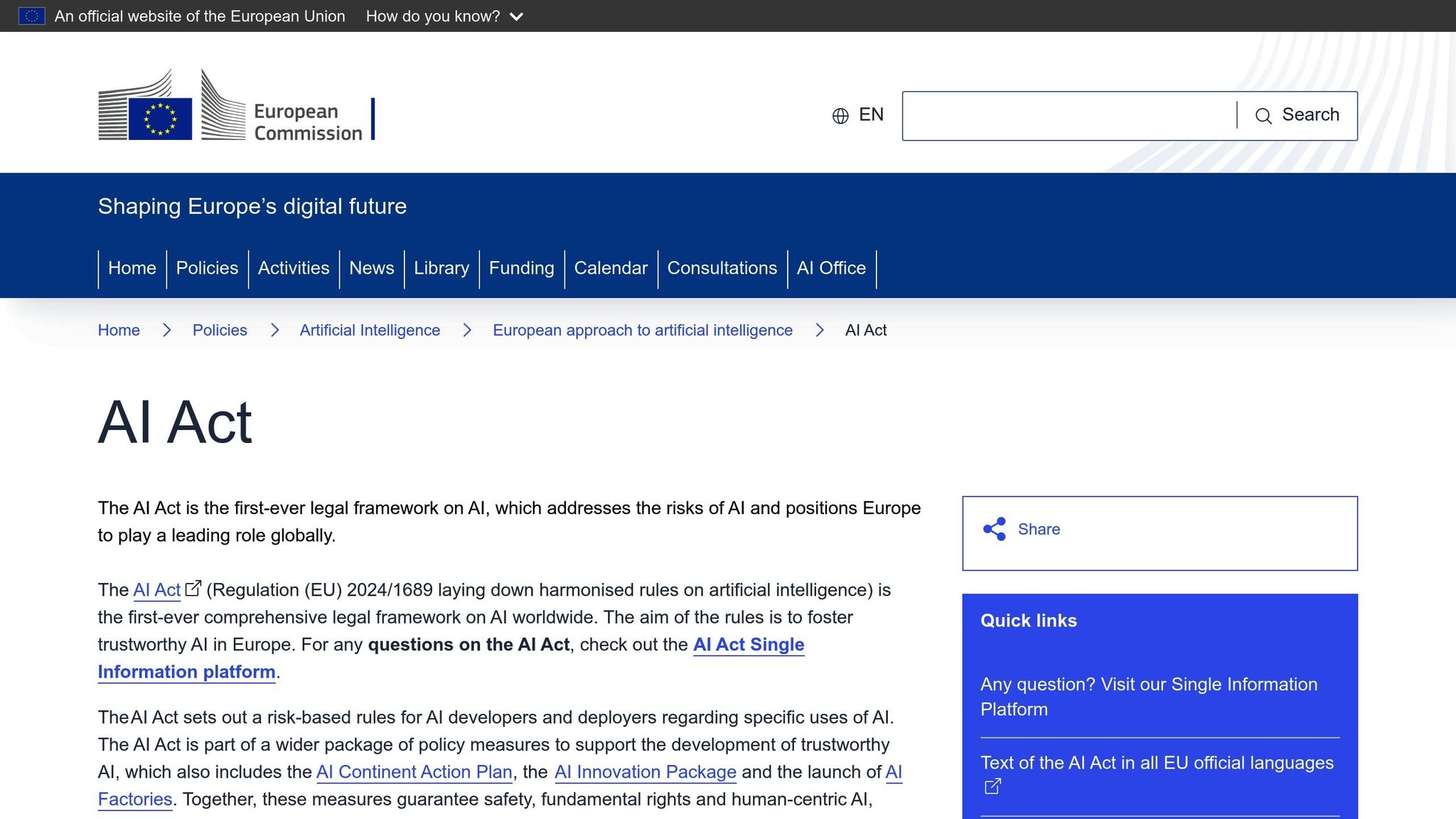
The EU AI Act is a standout example of a detailed, risk-based approach to regulating artificial intelligence. Coming into effect on 1 August 2024[3], it holds the distinction of being the first-ever AI regulation. The Act categorises AI systems into four risk levels, with each level dictating the degree of regulatory scrutiny required.
Risk Classification
The Unacceptable Risk category outright bans AI uses considered too dangerous. This includes practices like social scoring, manipulative behaviour tactics, and emotion recognition in workplaces or schools. Enforcement of these bans begins in February 2025[5]. Next, the High-Risk category focuses on AI systems in sensitive sectors such as transport, education, employment, and law enforcement. These systems face strict requirements, including risk management protocols, robust data governance, and mandatory human oversight[5].
The Transparency Risk category applies to tools like chatbots and deepfakes, which must clearly inform users when they're interacting with AI-generated content. Finally, the majority of AI applications - think spam filters or video games - fall into the Minimal or No Risk group and are not subject to additional regulations[5].
For general-purpose AI models, there are separate rules. Providers must meet transparency and copyright requirements, and any models deemed to pose "systemic risk" face extra obligations for risk assessment and mitigation[5].
These classifications come with stringent enforcement measures.
Enforcement Mechanisms
The penalties for non-compliance are hefty. Breaching bans on prohibited AI practices can result in fines of up to €35 million or 7% of global annual revenue, whichever is higher[1]. For general violations, fines can reach €15 million or 3% of turnover, and providing false information to regulators could cost up to €7.5 million or 1% of turnover[1]. Enforcement responsibilities are shared between the European AI Office at the EU level and national market surveillance authorities in each Member State[6]. To strengthen compliance, the Commission introduced a whistleblower tool in November 2025, enabling secure reporting of violations.
Certification Processes
High-risk AI systems must pass a conformity assessment before entering the market. For some systems, like those used in biometric identification, independent notified bodies handle the evaluation, while others can be self-assessed by providers[6]. Once approved, providers must issue an EU declaration of conformity and attach the CE marking, allowing the product to be legally sold in the European Single Market[4][5]. Additionally, all high-risk AI systems must be registered in a centralised EU database managed by the Commission. As the European Commission puts it:
"High-risk AI systems are subject to strict obligations before they can be put on the market"[5].
Cross-Border Applicability
The Act doesn’t just apply to businesses within the EU. It also covers providers and deployers from outside the EU if their AI systems are used within the European market[5]. This extraterritorial reach ensures that international companies must align with EU rules whenever their AI systems are operational in Europe.
2. NIST AI Risk Management Framework
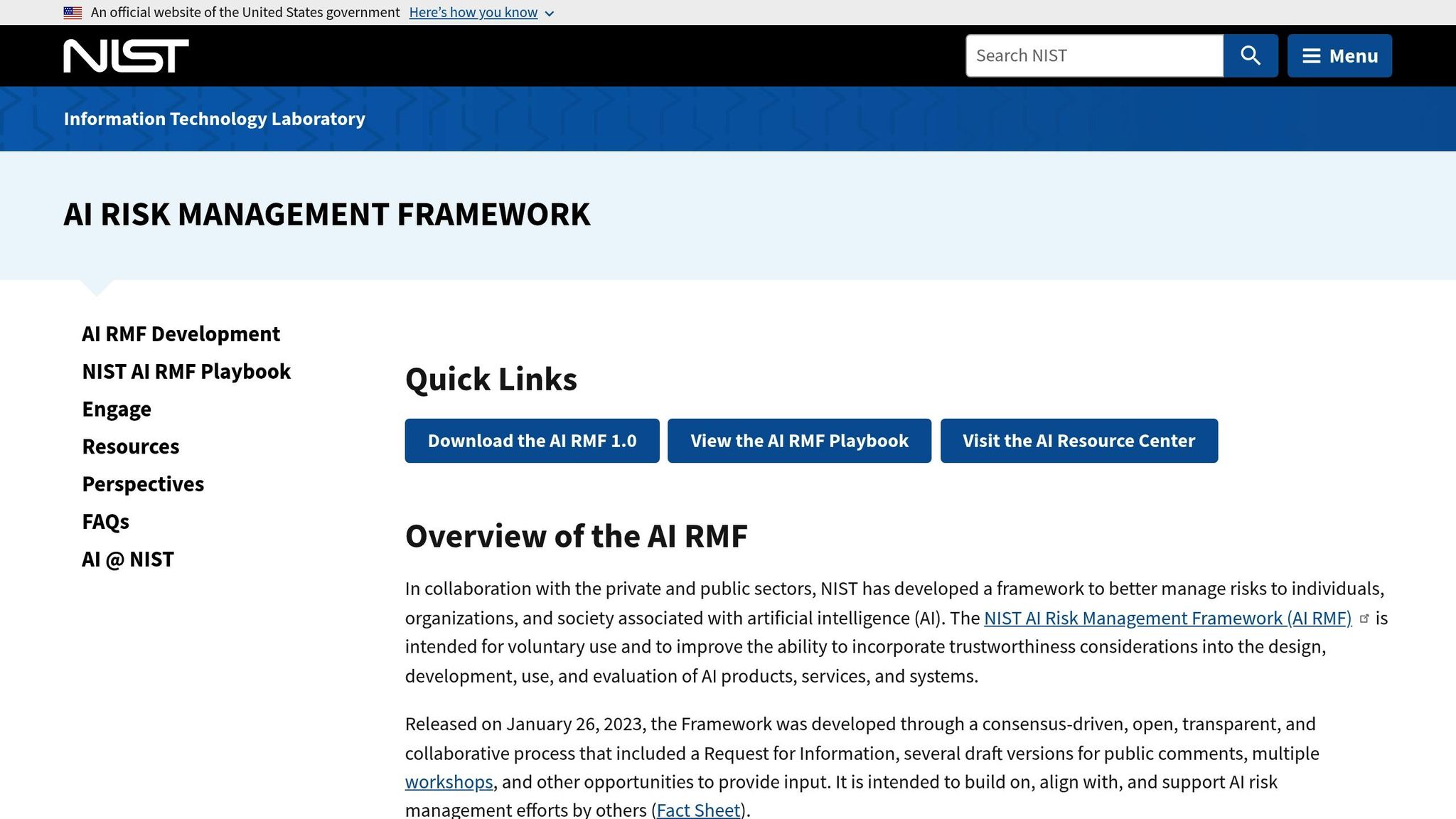
The NIST AI Risk Management Framework (AI RMF 1.0) stands apart from the EU AI Act in one key way: it’s entirely voluntary. Released on 26 January 2023, this framework was shaped by input from over 240 organisations [7][8]. Rather than imposing rules, it offers guidance for assessing and managing AI risks. This makes NIST’s approach more flexible compared to the regulatory nature of the EU AI Act.
The framework is built around four main functions: Govern, Map, Measure, and Manage. Here’s a quick breakdown:
- Govern: Establish a culture and structure for managing risks.
- Map: Pinpoint risks specific to the context.
- Measure: Use both quantitative and qualitative methods to evaluate risks.
- Manage: Focus on addressing and prioritising those risks.
NIST summarises its purpose nicely:
"The AI RMF Core provides outcomes and actions that enable dialogue, understanding, and activities to manage AI risks and responsibly develop trustworthy AI systems." [8]
What's particularly handy is the framework’s flexibility. It uses a 'Taxonomy of AI Risk,' which allows organisations to customise their approach. For instance, NIST released the Generative AI Profile (NIST-AI-600-1) on 26 July 2024, specifically addressing issues like synthetic content and AI hallucinations [7][9].
However, because it’s voluntary, the framework doesn’t come with enforcement measures, fines, or formal certifications. Instead, it serves as a toolkit for self-assessment.
Cross-Border Applicability
Although developed in the US, NIST has its eyes on the global stage. To encourage worldwide adoption, the Trustworthy and Responsible AI Resource Centre (AIRC) was launched on 30 March 2023 [7]. This initiative helps align AI practices globally and includes translations into languages like Arabic and Japanese. The goal? To make the framework accessible to organisations everywhere, so they can use it alongside local regulations like the EU AI Act or ISO standards.
3. ISO/IEC 42001
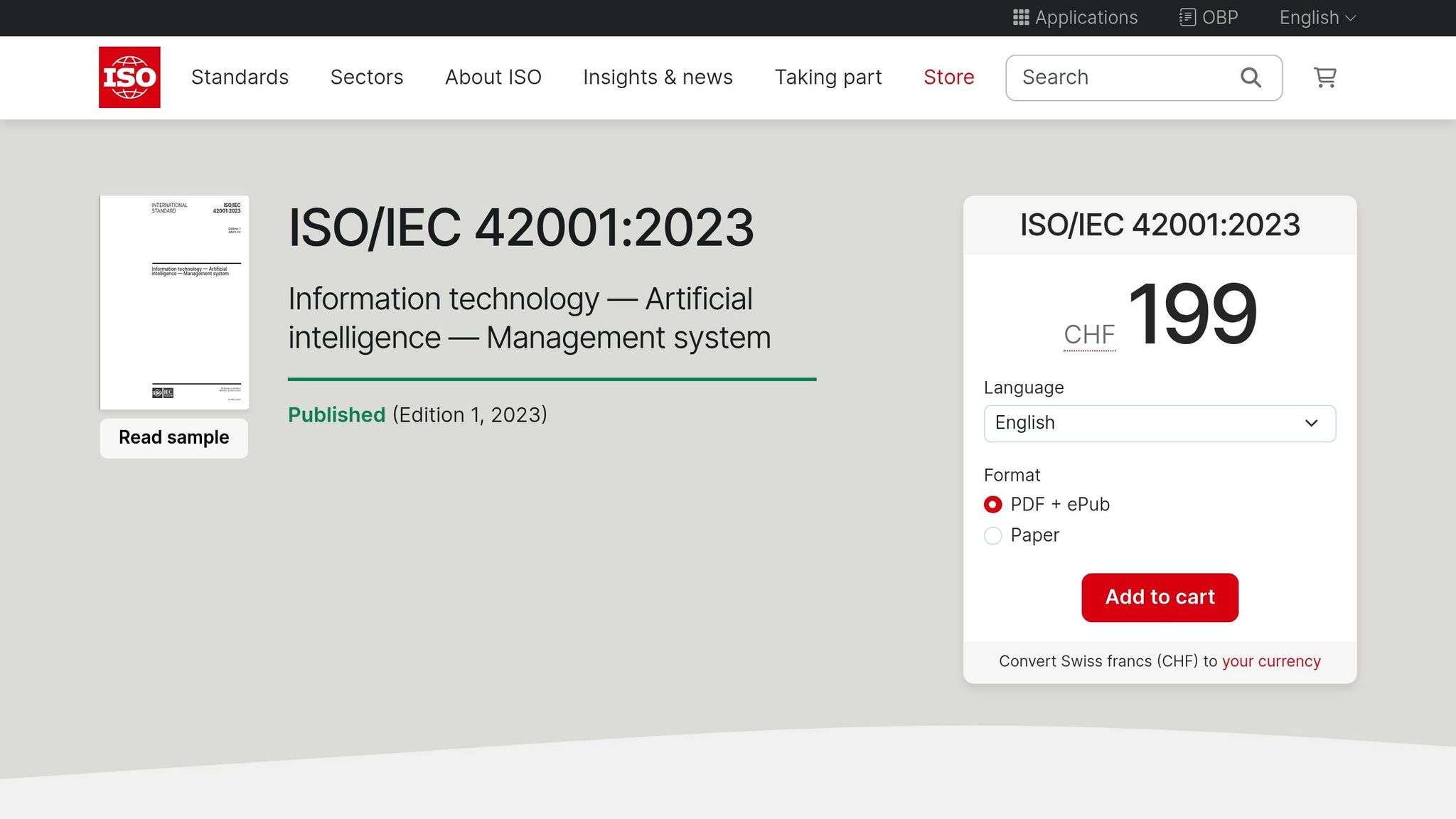
ISO/IEC 42001 is the first international standard specifically created to guide the establishment and maintenance of an AI Management System [11]. Essentially, it takes broad AI principles and translates them into practical, actionable requirements. Unlike binding regulations or voluntary guidelines, this standard offers a formal certification pathway, filling a gap in AI governance by providing a clear, certifiable benchmark.
The standard bridges the gap between policy objectives and technical implementation. As ISO explains:
"International standards transform high-level AI principles into practical requirements for the development of safe, transparent, trustworthy and responsible AI systems." [10]
ISO/IEC 42001 tackles the challenge of fragmented AI laws by presenting a unified framework recognised worldwide. It addresses every stage of the AI lifecycle, including critical areas like risk management, data governance, transparency, and sustainability [10]. Drawing inspiration from standards like ISO 9001 and ISO 27001, it uses a cyclical approach of planning, implementing, monitoring, and improving [11].
Certification Processes
Organisations can gain certification for ISO/IEC 42001 through an independent third-party audit, which results in a straightforward pass or fail outcome. Achieving certification not only confirms compliance but could also act as evidence of meeting legal obligations. For instance, in the context of the EU AI Act, adhering to ISO/IEC 42001 may help demonstrate compliance with regulatory requirements. As the EU AI Act notes:
"compliance with standards…should be a means for providers to demonstrate conformity with the requirements of this Regulation." [12]
Cross-Border Applicability
One of the standout features of ISO/IEC 42001 is its global perspective. It aims to harmonise practices across borders, addressing the technical and regulatory inconsistencies that arise from varying national AI laws [10]. By offering a common framework that’s recognised internationally, this standard simplifies market entry and operations for organisations working across multiple jurisdictions. Whether navigating the EU AI Act, California's SB 53, or other regional frameworks, ISO/IEC 42001 provides a consistent approach to meet diverse regulatory demands.
sbb-itb-fe42743
4. UN and WEF Global Proposals
Unlike rigid regulations and standardised certifications, the proposals from the UN and the World Economic Forum (WEF) focus on fostering international dialogue and adaptive governance. Instead of enforcing strict rules, they suggest a flexible framework that evolves alongside technological advancements. A prime example is the UN High-level Advisory Body on AI, which released its final report, "Governing AI for Humanity," in September 2024. This report was the result of extensive global consultations[15]. The approach here is more about collaboration and adaptability, standing in contrast to the stricter regulatory models previously discussed.
Risk Classification
While formal standards often rely on predefined risk categories, the UN's method takes a more fluid and qualitative route. Through initiatives like the "AI Risk Global Pulse Check," the organisation prioritises assessments that focus on protecting human rights, ensuring data privacy, and reducing algorithmic biases[15][16]. This framework is designed to evolve with the rapid pace of AI development, using regular "pulse checks" to stay relevant and up-to-date[15].
Enforcement Mechanisms
Rather than establishing a centralised enforcement body, the UN advocates for minimal institutional oversight[15]. As the UN Advisory Body on Artificial Intelligence puts it:
"Urging the UN to lay the foundations of the first globally inclusive and distributed architecture for AI governance based on international cooperation."[15]
This model relies on voluntary collaboration between governments, industries, and civil society. The emphasis is on agility and global cooperation, which complements the more formal frameworks discussed earlier.
Cross-Border Applicability
UNESCO's "Recommendation on the Ethics of Artificial Intelligence" offers a global framework aimed at aligning national policies with international human rights standards. Its Global AI Ethics and Governance Observatory serves as a platform for sharing best practices[13]. Additionally, the Readiness Assessment Methodology (RAM) helps nations evaluate their preparedness for AI adoption[13]. A key principle of UNESCO's approach is the protection of human rights and dignity. As the Recommendation states:
"The protection of human rights and dignity is the cornerstone of the Recommendation, based on the advancement of fundamental principles such as transparency and fairness."[13]
This multi-stakeholder model balances respect for national sovereignty with the goal of international alignment. It also seeks to bridge the AI gap between developed and developing nations, ensuring a more equitable global approach to AI governance[15].
5. US Executive Order 14179 and National Strategies
The United States has taken a very different route from the EU when it comes to regulating AI. Instead of creating a single, overarching framework like the EU, the US has opted for a mix-and-match approach. This "patchwork" strategy relies on Executive Orders, proposed laws, and state-level actions that tackle specific issues, such as election security and transparency requirements[2]. The focus here is less on protecting individual rights and more on promoting "responsible innovation" and safeguarding national security[2]. It's a clear reflection of the US's preference for encouraging innovation over imposing uniform rules.
Risk Classification
California's SB 53, signed into law on 29 September 2025, is a good example of how the US approach works. It specifically targets "frontier models" - AI systems with computing power exceeding 10^26 operations. To put that into perspective, that's even stricter than the EU AI Act, which sets the bar at 10^25 FLOPs[1]. SB 53 also has a narrower definition of "catastrophic risk", limiting it to incidents causing 50 or more deaths or damages exceeding $1 billion. By comparison, the EU casts a wider net, regulating large developers with annual revenues over $500 million[1].
Enforcement Mechanisms
Under SB 53, enforcement falls to the California Attorney General, and penalties are capped at $1 million[1]. This is a far cry from the EU AI Act, where fines can reach up to €35 million or 7% of a company's global turnover[2]. The US's lighter touch continues with the Bipartisan Framework for a US AI Act, which suggests creating an independent oversight body and introducing licensing for AI systems. While this mirrors the EU's conformity assessments, the US framework places its emphasis firmly on national priorities rather than individual rights[2].
Cross-Border Applicability
For international organisations, navigating the differences between these frameworks is no small task. The EU targets AI deployers, while SB 53 does not, leaving gaps that could complicate compliance efforts[1]. Companies operating across borders may find themselves needing a dual compliance strategy to meet both sets of requirements. This divergence highlights the growing challenge of aligning global AI regulations.
Advantages and Disadvantages
Let’s take a closer look at the strengths and weaknesses of the key frameworks discussed. Each one brings something different to the table, but they also come with their own challenges.
The EU AI Act is undeniably thorough, offering legally binding protection through its tiered risk system. However, its complexity and the resources required for compliance could be a heavy burden for smaller organisations. Haley Fine, Associate General Counsel at SiriusXM, pointed out that the Act "was anticipated to catalyse other AI governance frameworks in the same way the EU General Data Protection Regulation inspired privacy laws around the world" [1]. The Act’s steep fines - up to 7% of global turnover - show just how serious non-compliance can be.
Moving on to ISO/IEC 42001, this framework stands out as the only internationally certifiable standard. Organisations that achieve formal AIMS certification can boost their credibility significantly [11]. But there’s a catch - it’s entirely voluntary. Adoption relies on market demand rather than legal enforcement, which means uptake could be inconsistent. Similarly, the NIST AI Risk Management Framework is voluntary. Its functional approach - Govern, Map, Measure, Manage - offers flexibility, but the lack of formal enforcement limits its impact [17]. John Jainschigg, Director of Open Source Initiatives at Mirantis, warns:
"Without policies in place, enterprises risk more than simple inefficiencies. They risk: Legal penalties, Costly outages, Reputational damage" [11].
The UN and WEF proposals, on the other hand, are all about promoting global cooperation and tackling ethical concerns across more than 193 states. While this sounds great in theory, their recommendations are non-binding, meaning they lack the enforcement power to bring about real change [17].
Finally, there’s California's SB 53, which takes a very specific approach. It focuses on frontier models exceeding 10^26 FLOPs and imposes capped penalties of up to $1 million [1]. This narrow focus makes it easier to implement but leaves significant gaps, as it doesn’t regulate AI deployers more broadly.
Here’s a quick comparison of these frameworks:
| Framework | Risk Classification | Enforcement Mechanisms | Certification Processes | Cross-Border Applicability |
|---|---|---|---|---|
| EU AI Act | Tiered (Unacceptable to Minimal) | Fines (up to 7% turnover) | Conformity Assessment | EU-wide; Extraterritorial |
| NIST AI RMF | Functional (Govern, Map, Measure, Manage) | Voluntary; Industry adoption | No | Global (US-led) |
| ISO/IEC 42001 | Management System (AIMS) | Voluntary; Contractual | Yes (Certifiable) | International Standard |
| UN and WEF proposals | Ethical/Societal Principles | Non-binding; Policy guidance | No | Global (193+ states) |
| California's SB 53 | Compute-based (Frontier Models) | Civil actions (up to $1 million) | No | US/California-specific |
Each framework has its role, but it’s clear that no single one can address all the challenges of AI governance. The choice often depends on balancing thoroughness with practicality, and whether enforcement or flexibility is the priority.
Conclusion
When we look at the various global frameworks for AI governance, it’s clear that each brings its own strengths and challenges to the table. The EU AI Act, for instance, stands out as a legally binding framework with its risk-based classification system. However, this thoroughness comes with a price - it demands significant resources, making compliance a must for anyone operating in Europe. On the other hand, frameworks like the NIST AI Risk Management Framework and ISO/IEC 42001 are voluntary and more flexible, which makes them attractive for international adoption. But they rely on market-driven uptake rather than legal enforcement. Then there’s the UNESCO Recommendation - a set of ethical principles agreed upon by 194 member states - but without enforcement mechanisms, its impact is limited [13].
The real challenge lies in moving from high-level principles to practical, actionable governance. This means weaving compliance, privacy, and ethical considerations directly into the technical fabric of AI systems [14]. Organisations need tools like comprehensive impact assessments, continuous audit trails, and cross-functional oversight teams that bring together tech, legal, and business expertise [11][14].
For companies in the UK and Europe, the task of navigating these frameworks can feel overwhelming. That’s where technical oversight becomes critical. Services like Vibe-Code Fixes from Metamindz can step in to provide hands-on, CTO-led guidance for AI projects. This kind of support helps organisations translate complex regulatory requirements into detailed, verifiable technical documentation. It also prepares them for conformity assessments under the EU AI Act and establishes systems for ongoing monitoring - catching issues like model drift or vulnerabilities before they spiral into costly problems. Plus, this approach aligns seamlessly with global regulatory expectations.
Ultimately, responsible AI governance isn’t just about ticking boxes; it’s about building trust and enabling innovation. With the right technical support and a solid grasp of the regulatory landscape, compliance becomes less of a hurdle and more of a springboard for success.
FAQs
How does the EU AI Act differ from the NIST AI Risk Management Framework?
The EU AI Act and the NIST AI Risk Management Framework (RMF) take different paths when it comes to AI governance, reflecting the unique priorities and contexts of their origins.
The EU AI Act leans heavily towards regulation. It introduces strict rules, especially for what's deemed "high-risk" AI systems. These rules cover areas like risk management, data governance, transparency, and human oversight. Essentially, it aims to create a unified legal structure across EU member states to ensure AI is used ethically and safely.
On the other hand, the NIST AI RMF - developed in the United States - takes a more flexible approach. Instead of enforcing regulations, it offers voluntary guidelines to help organisations navigate AI risks. While the details of the framework aren’t fully outlined here, it’s clear that its focus is more on supporting innovation while addressing potential risks, rather than imposing strict controls.
If you have access to more detailed insights about the NIST AI RMF, it would be possible to delve deeper into how these two frameworks compare.
What are the benefits of ISO/IEC 42001 certification for complying with global AI regulations?
ISO/IEC 42001 certification offers organisations a structured framework to ensure their AI systems align with global standards for quality, safety, risk management, and data governance. By following these guidelines, businesses can show they comply with international AI principles while also meeting various regional regulations.
Beyond simplifying the maze of global AI governance, this certification helps build trust with stakeholders by highlighting a commitment to ethical and responsible AI practices. It’s a clear signal that an organisation prioritises accountability and transparency in how it develops and uses AI.
Why don’t we have a single global standard for AI governance?
A universal standard for AI governance is yet to emerge, largely because countries and regions have their own unique priorities, values, and methods for handling the risks and benefits of AI. Each government crafts its own set of rules, frameworks, and ethical principles tailored to local needs, all while trying to encourage innovation.
This has led to a patchwork of AI governance strategies around the world, shaped by differences in legal systems, economic goals, and societal norms. Although there are international efforts to align these approaches, creating a single, unified framework is no easy task. The challenge lies in finding the right balance between global cooperation and the sovereignty of individual nations.